Yogi Berra the great American baseball coach when pressed on how his team would perform in the coming season replied “It’s tough to make predictions, especially about the future.” Berra’s experiences in the challenging world of baseball may have led him to err on the cautious side but since time memorial there have been many pundits and oracles all too willing to take the great leap and offer predictions on our futures.
We know all too well the complete and catastrophic failure of our political and financial institutions to predict economic downturns but on the other hand progress in the accuracy of weather forecasts for example has been steady with computer power improving exponentially over recent decades. Generally however it remains a minefield as the management guru Peter Drucker explains to predict the future is “like trying to drive down a country road at night with no lights while looking out the back window.” That maybe so but performances of business teams in many organisations depends precisely on making accurate predictions and sometimes governs their very existence. Visualising the future and then providing prescriptions for the public domain can take on many connotations but the making of forecasts or predictions are actually institutionalised into the way businesses operate and reach decisions. In particular the ritual of the annual sales forecast which many organisations rely on for the coming year to drive the plans and budgets on the supply side such as procurement, engineering, HR etc. How the sales team derive the figures, the formulas they use and how they measure their accuracy are topics for regular discussion in board meetings. Forecasts from the customer, economic conditions, product life cycle and historical trends are to name just some of the variables thrown in to the mix but as complexity continues to grow in the global market place all too often “the best laid schemes oft go awry” and depending on the distance from target can cause major disruptions in the planning of resources for the coming year. Schedulers who operate wholly computer based MRP (Manufacturing Requirements Planning) systems to meet the forecasts know all too well the problems if forecasts aren’t converted accurately into solid orders. The MRP system requires manufacturing to produce the required parts and push them onto the next process until they reach finished goods. The dilemma (Fig 1) faced by operational planners is how much of the plan can actually be taken at face value to provide the optimum service levels without tying up too much working capital in the process. Their mode of operation is usually based on unsatisfactory and constantly changing compromises which in particular can be highlighted by how many times the forecasts are updated as the year evolves. The over exuberance of business development teams at the prospect of increased sales can send the wrong signals and schedulers all too aware of the risks put a greater reliance on stock holdings resulting in restricted cash flows and increased operating costs. The dilemma is shown in the model below:
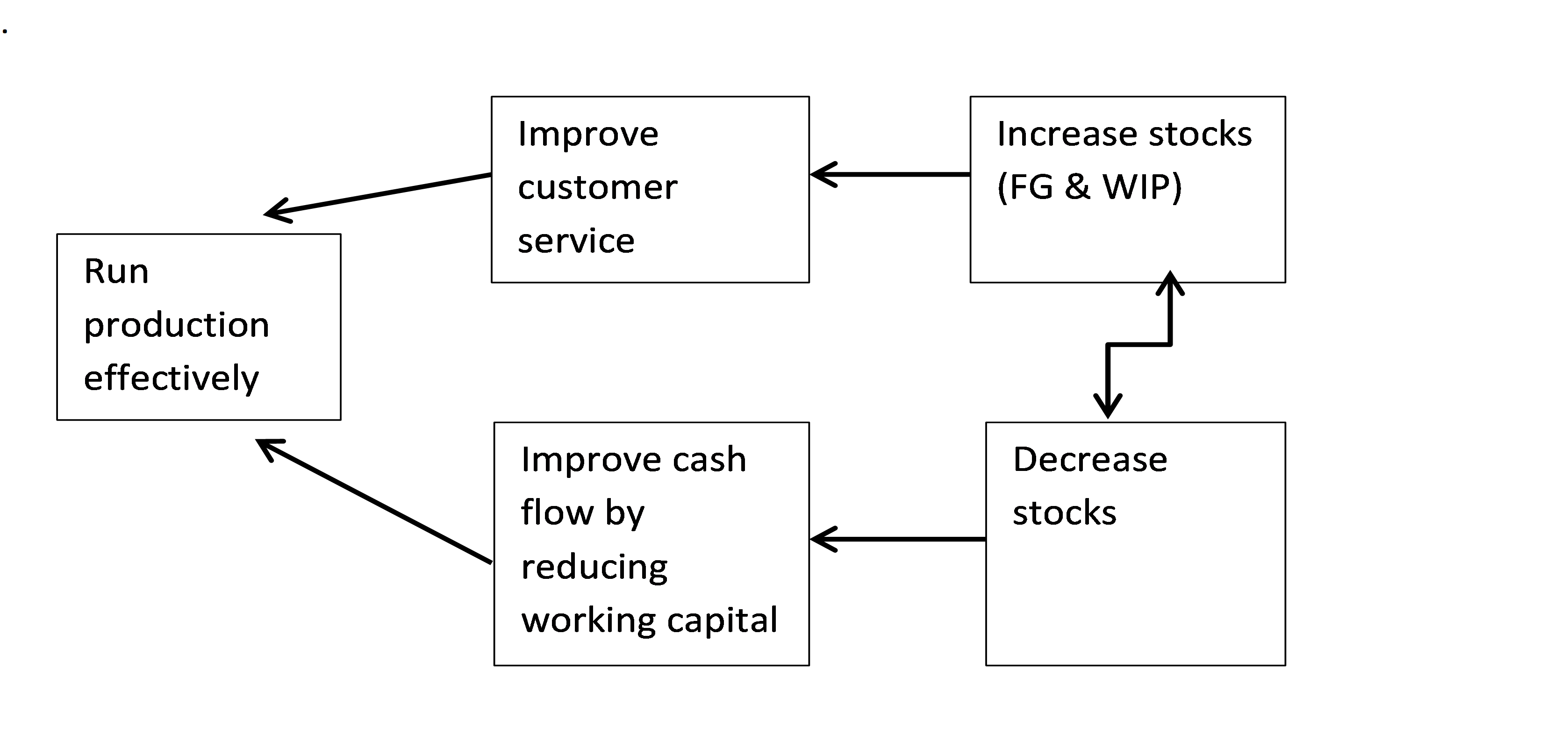
Unlocking the dilemma
Step 1: Product Categorisation - Runners, Repeaters & Strangers (RRS) & Planning mode
What instead if most of the noise from the external environment could be replaced with signals along the supply chain to instruct each stage what needs to be produced? The level of risk in reliance on the forecast solely as the driver would be reduced considerably resulting in improved accuracy which would deliver significant customer service and lower operating cost benefits to the business. The stalwart tools required to achieve this improved supply chain performance comes in the form of a combination from the Lean & Goldratt Institutes best practice models. Firstly the mode of planning can be determined by categorising the products based on existing run rates (Fig 2) example below.

Thought to have originated in Lucas Industries during the late 1980s the product categorisation into Runners, Repeaters and Strangers forms part of an excellent strategy for production scheduling and supply chain management. When applying the Venetians rule (Pareto analysis) to the RRS v current throughput rates the Runners - products or product family having sufficient volume to justify dedicated facilities or manufacturing cells make up to ~ 60% sold as the example above demonstrates. A Repeater is a product or product family with intermediate volume, where dedicated facilities are not justifiable showing a further ~ 15% and the Strangers are a product or family with low intermittent volumes making up to ~ 25% volume but making up over 70% of the products. Of course there will be variations across industries but the principles remain the same that being classified will determine the optimum scheduling mode of operation (Fig 3).
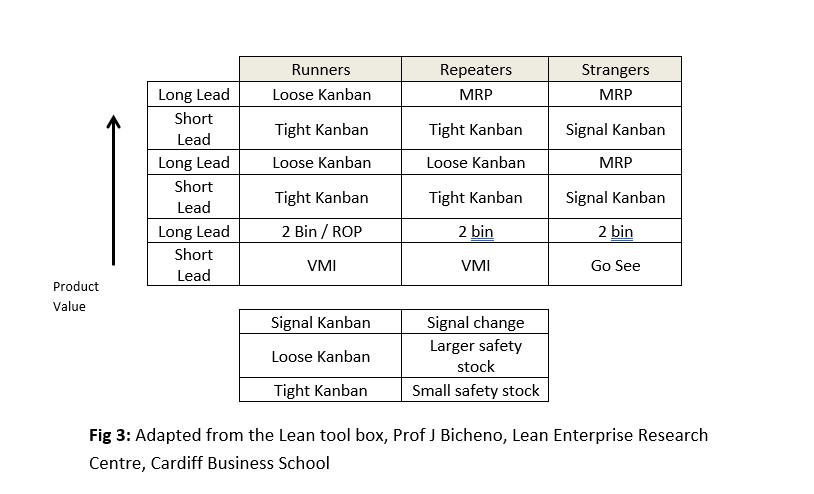
Step 3: Combine RRS and Constraint Management Scheduling
Constraint Management (CM), is a philosophy and set of techniques used to manage the throughput of an organisation. Most widely implemented in manufacturing operations, it teaches management how to identify and direct their focus on the few critical drivers. CM begins with one underlying assumption; the performance of the system's constraint will determine the throughput of the entire system. Put simply the strength of the supply chain is determined at the weakest point or alternatively the pace of the entire supply chain is controlled by the slowest processes. In scheduling terms (Fig 4) it means:
1. Developing a detailed schedule for the constraint resource
2. Add buffers to protect the throughput of that resource
3. Synchronise all other resources to the constraint schedule
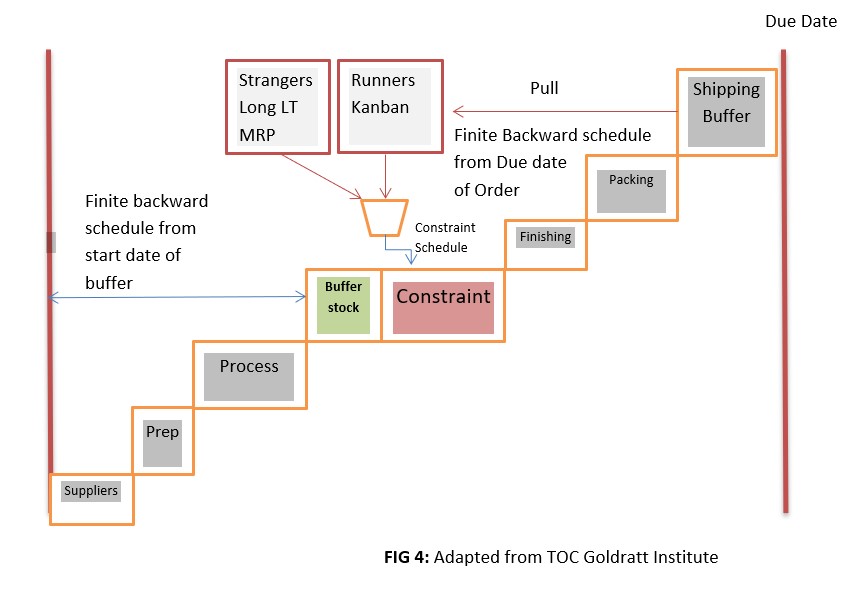
How does the buffer work?
The buffer is a period of time to protect the constraint resource from problems that occur upstream. Its effect to provide a resynchronization of the work as it flows through the plant. The buffer compensates for process variation, and makes schedules very stable and immune to most problems. It has the additional effect of eliminating the need for 100% accurate data for scheduling. It allows the user to produce a “good enough” schedule that will generate superior results over almost every other scheduling method!
Synchronise to the Constraint
After the Constraint has been scheduled, material release and shipping are connected to it, using the buffer offset. Material and parts are released at the same rate as the constraint can consume it. Orders are shipped at the rate of Constraint production.
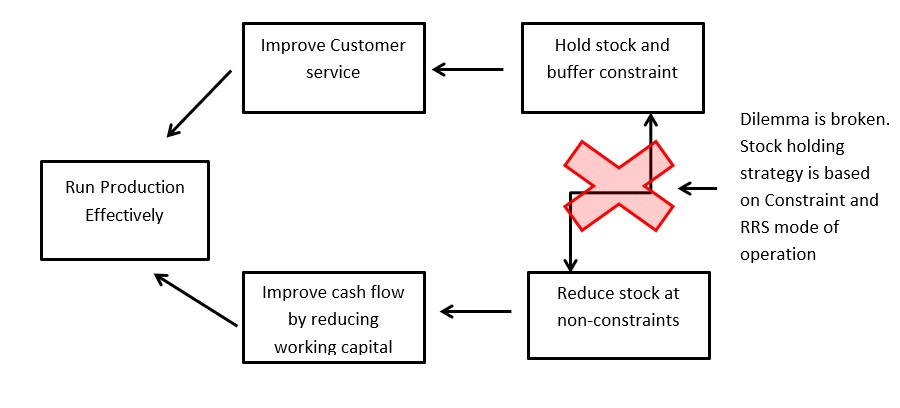
Of course implementing the 3 step programme will face different organisational, managerial and cultural contexts and the large stock mentality can be hard to break down in some companies. The scheduler’s role changes completely under the new system from the classic expeditor to strategic planning choices for each product classification. Investing in a production planning and scheduling system that makes to order or stock depending on the product classification with a modus operandi along the value stream combined with Goldratt’s very effective theory of constraint (TOC) principles will provide the platform for a winning stock holding strategy. Furthermore the inherent risks on a wholly reliant Sales Forecasting system to determine resources will be greatly reduced.